

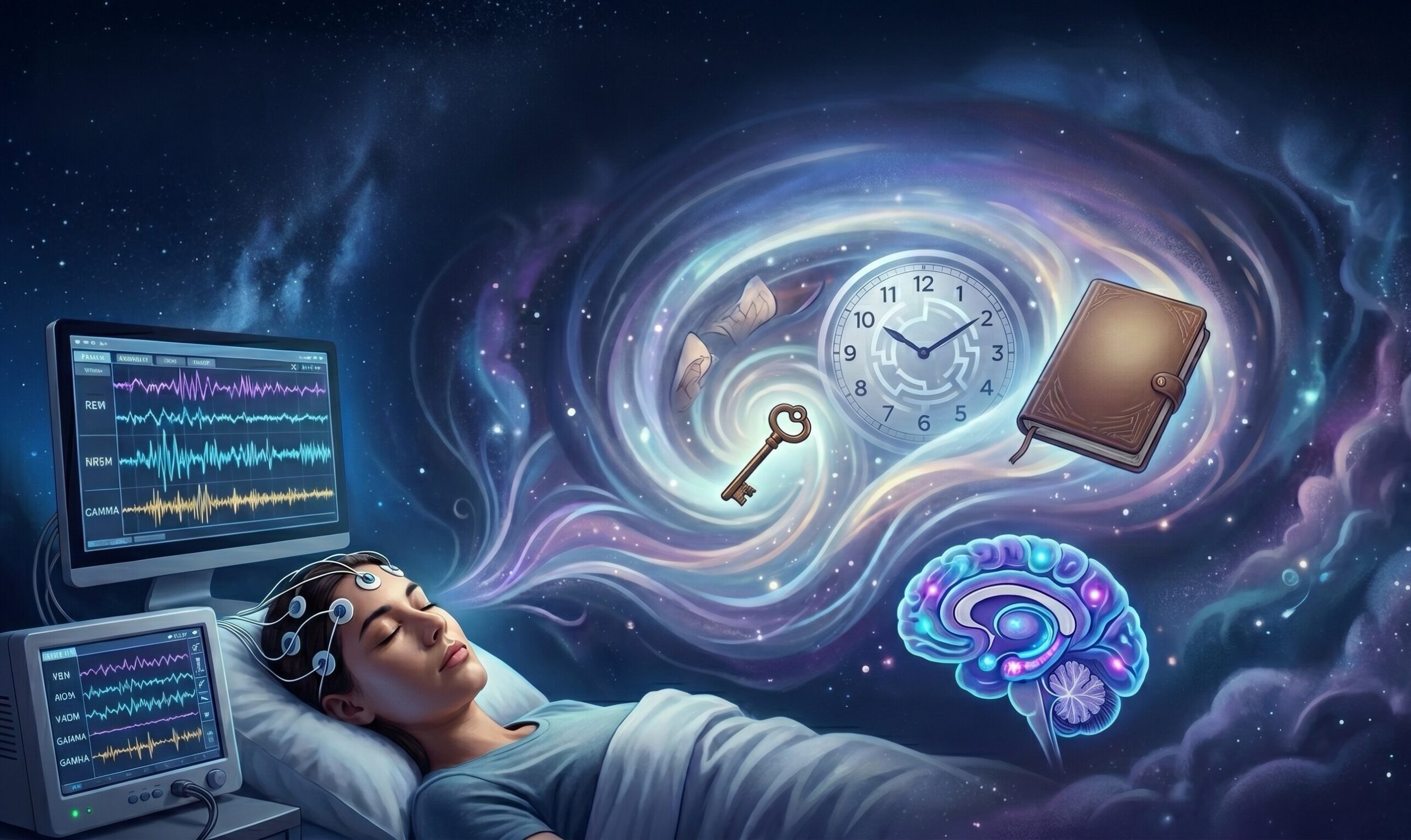
Dreams have fascinated humanity for thousands of years.
Ancient civilizations viewed dreams as messages from the gods. Religious traditions often regarded them as signs, warnings, or prophecies. Philosophers debated whether dreams revealed hidden truths about human nature, while psychologists later argued that dreams could provide a window into the subconscious mind.
Despite centuries of fascination, dreams remain one of the most mysterious aspects of human experience.
Every night, billions of people enter dream states. Some dreams are vivid and emotional. Others seem random, confusing, or quickly forgotten. Some individuals report recurring dreams that persist for years, while others experience lucid dreams in which they become aware that they are dreaming.
This raises a fundamental question:
Can dreams be studied scientifically?
The answer is yes.
The scientific study of dreams is known as oneirology, a field that combines neuroscience, psychology, sleep research, and cognitive science to investigate why dreams occur, how they form, and what role they may play in the human brain.
Although researchers still disagree on many aspects of dreaming, modern science has made remarkable progress in understanding what happens inside the sleeping mind.
In this guide, we’ll explore what oneirology is, where it came from, how scientists study dreams, and what modern research has revealed about one of humanity’s greatest mysteries.
Quick Answer
Oneirology is the scientific study of dreams. The field examines how dreams occur, what brain processes are involved in dreaming, why people dream, and how dreams may relate to memory, emotions, learning, and consciousness.
Unlike dream interpretation, which focuses on possible meanings or symbolism, oneirology seeks to understand dreams through scientific observation, experimentation, neuroscience, psychology, and sleep research.
Although researchers have learned a great deal about dreaming over the past century, many questions remain unanswered, making oneirology one of the most fascinating areas of modern science.
What Is Oneirology?
The word “oneirology” comes from the Greek word oneiros, meaning “dream,” and logos, meaning “study” or “science.”
In simple terms, oneirology refers to the scientific investigation of dreams.
Researchers in this field seek to answer questions such as:
- Why do humans dream?
- What happens in the brain during dreaming?
- Why do some dreams feel realistic while others feel bizarre?
- Why are dreams often forgotten?
- Can dreams influence emotions and memory?
- What is the relationship between dreaming and consciousness?
Unlike traditional dream interpretation, oneirology does not attempt to assign universal meanings to dream symbols. Instead, researchers focus on measurable biological and psychological processes.
For example, a dream interpreter may suggest that dreaming about water symbolizes emotions or transformation. A oneirologist, however, would be more interested in understanding how the dream was generated, which brain regions were active, and what cognitive processes contributed to the experience.
This distinction is important.
Dream interpretation and oneirology often address the same phenomenon—dreaming—but from very different perspectives.
One seeks meaning.
The other seeks evidence.
The Origins of Oneirology
Humans have been curious about dreams for as long as written history has existed.
Ancient Egyptian, Greek, Chinese, Indian, and Mesopotamian cultures all left records describing dreams and their perceived significance. In many societies, dreams were believed to contain messages from supernatural forces, ancestors, or deities.
For most of human history, however, dreams were primarily viewed through religious, spiritual, or philosophical lenses.
Scientific investigation arrived much later.
A major turning point occurred in the late nineteenth and early twentieth centuries when psychologists began studying dreams systematically.
One of the most influential figures was Sigmund Freud, whose 1899 book The Interpretation of Dreams argued that dreams represented hidden wishes and unconscious desires.
Freud’s theories became enormously influential, but many of his conclusions were difficult to verify scientifically.
Several decades later, Carl Jung proposed a different approach. Jung believed dreams reflected broader psychological patterns and archetypes shared across humanity.
While Freud and Jung shaped public understanding of dreams, modern oneirology eventually moved beyond purely interpretive approaches and toward measurable scientific methods.
The field expanded dramatically during the twentieth century as researchers developed technologies capable of observing the sleeping brain.
The discovery of REM sleep would become one of the most important breakthroughs in the history of dream research.
Why Humans Dream
Despite decades of research, scientists still do not fully agree on why humans dream.
This may sound surprising given how common dreaming is, but dreams remain extraordinarily difficult to study.
Unlike many biological processes, dreams occur within subjective conscious experience. Researchers cannot directly observe a dream as it unfolds. Instead, they must rely on brain measurements and participants’ descriptions after waking.
As a result, multiple theories have emerged.
Some researchers believe dreams help process emotions and experiences from daily life.
Others suggest dreams play a role in consolidating memories and integrating new information into existing knowledge.
Some theories argue that dreams help the brain simulate challenges, rehearse responses, or prepare for future situations.
Still others propose that dreams may simply be a byproduct of normal brain activity occurring during sleep.
Modern oneirology does not view these theories as necessarily competing explanations. It is entirely possible that dreams serve multiple functions simultaneously.
The brain is an extraordinarily complex organ, and dreaming may represent the interaction of several cognitive and neurological processes rather than a single purpose.
What researchers generally agree on is that dreaming appears to be closely connected to memory, emotion, learning, and consciousness.
Exactly how these elements interact remains one of the field’s most important unanswered questions.
How Scientists Study Dreams
Studying dreams presents a unique challenge.
Researchers cannot directly enter another person’s dream experience. They must rely on indirect methods to investigate what happens during sleep.
Modern dream research typically combines several approaches.
One of the most important tools is polysomnography, a technique that records multiple physiological signals during sleep. Researchers monitor brain activity, eye movements, muscle activity, breathing patterns, and heart rate.
Electroencephalography (EEG) allows scientists to measure electrical activity in the brain while a person sleeps. These recordings help identify different sleep stages and reveal patterns associated with dreaming.
Researchers may wake participants during specific sleep stages and ask them to describe what they were experiencing immediately before awakening.
This approach has generated some of the strongest evidence linking certain stages of sleep to dream activity.
Advances in neuroimaging have provided additional insights.
Functional magnetic resonance imaging (fMRI) and positron emission tomography (PET) scans have allowed scientists to examine which brain regions become more or less active during dreaming.
These studies have revealed that areas involved in emotion, memory, and visual processing often remain highly active during dreams, while regions associated with logical reasoning and critical evaluation may become less active.
This pattern may help explain why dreams can feel emotionally intense while simultaneously containing bizarre or illogical elements that seem perfectly normal until we wake up.
As technology continues to improve, researchers are gaining increasingly sophisticated tools for investigating the sleeping brain.
Yet despite these advances, dreaming remains one of the most difficult phenomena in neuroscience to fully understand.
REM Sleep and the Dreaming Brain
One of the most important discoveries in the history of oneirology came in 1953, when researchers Eugene Aserinsky and Nathaniel Kleitman identified a previously unknown stage of sleep characterized by rapid eye movements.
This stage became known as Rapid Eye Movement (REM) sleep.
The discovery transformed dream research.
Scientists found that people awakened during REM sleep frequently reported vivid, story-like dreams. These dreams often contained strong emotions, detailed imagery, and complex narratives.
Before this discovery, many researchers believed sleep was largely a passive state during which the brain simply rested. REM research revealed something very different.
During REM sleep, parts of the brain become remarkably active. In some respects, brain activity during REM resembles activity observed while awake.
Research has shown increased activity in regions associated with:
- Emotion
- Memory processing
- Visual imagery
- Internal attention
At the same time, some areas involved in logical reasoning, self-monitoring, and critical evaluation appear less active.
This combination may help explain why dreams often feel emotionally intense while also containing impossible events that seem completely normal at the time.
For example, a dreamer may accept flying through the air, speaking with a deceased relative, or instantly changing locations without questioning the experience.
The brain’s emotional and imaginative systems remain highly engaged, while the systems responsible for reality checking appear less active.
Although REM sleep is strongly associated with vivid dreaming, modern research has shown that dreams can occur in other sleep stages as well. People awakened from non-REM sleep sometimes report dream-like experiences, although these tend to be shorter, less vivid, and less narrative in structure.
This finding challenged the earlier assumption that dreaming occurs exclusively during REM sleep and remains an important area of ongoing research.
Major Theories of Dreaming
One of the central goals of oneirology is understanding why dreams exist in the first place.
Despite decades of investigation, no single theory has gained universal acceptance.
Instead, several influential models attempt to explain different aspects of dreaming.
The Activation-Synthesis Theory
One of the most influential modern theories was proposed by J. Allan Hobson and Robert McCarley in the 1970s.
According to the Activation-Synthesis Theory, dreams result from the brain attempting to make sense of internally generated neural activity during sleep.
In this view, random signals originating in the brainstem activate various parts of the brain. The cortex then attempts to organize these signals into a coherent narrative, producing the experience we recognize as a dream.
The theory was important because it shifted attention away from symbolic interpretations and toward biological mechanisms.
However, many researchers believe the theory oversimplifies dreaming. Dreams often contain meaningful emotional themes and personal concerns that seem difficult to explain through random neural activity alone.
Memory Consolidation Theory
Another influential perspective suggests that dreams are connected to memory processing.
Research supported by organizations such as the National Institutes of Health has shown that sleep plays a critical role in memory consolidation.
During sleep, the brain appears to strengthen certain memories, reorganize information, and integrate new experiences with existing knowledge.
Some researchers propose that dreams may reflect this process.
This theory helps explain why recent experiences, unresolved concerns, and emotionally significant events frequently appear in dreams.
Rather than serving no purpose, dreams may represent the brain’s efforts to organize and process information accumulated during waking life.
Emotional Processing Theory
Many dream researchers believe dreams play a role in emotional regulation.
During sleep, individuals often revisit emotionally significant situations in altered forms. An argument, a stressful event, a major life change, or a personal fear may reappear in symbolic or distorted ways.
According to this perspective, dreaming may help people process difficult emotions in a relatively safe environment.
Although much remains unknown, growing evidence suggests that dreaming and emotional well-being may be closely connected.
Threat Simulation Theory
Proposed by Finnish cognitive neuroscientist Antti Revonsuo, the Threat Simulation Theory argues that dreams evolved as a survival mechanism.
According to this model, dreams allow individuals to mentally rehearse threatening situations without facing real-world danger.
This may help explain why common dream themes include:
- Being chased
- Falling
- Being attacked
- Getting lost
- Failing important tasks
From an evolutionary perspective, practicing responses to danger in a simulated environment could have provided survival advantages.
Although not universally accepted, this theory offers an intriguing explanation for why negative dream content appears so frequently across cultures.
Modern Predictive Processing Models
More recent theories draw from advances in neuroscience and cognitive science.
Some researchers suggest that the brain functions as a prediction-generating system, constantly attempting to model reality and anticipate future events.
Dreams may represent part of this predictive process.
During sleep, the brain may test possibilities, simulate scenarios, and reorganize internal models of the world.
These theories remain under active investigation but reflect the growing complexity of modern dream science.
Famous Researchers Who Shaped Oneirology
The development of oneirology has been influenced by scientists, psychologists, and sleep researchers from many disciplines.
Sigmund Freud
Although many of Freud’s theories remain controversial, his work helped establish dreams as a subject worthy of systematic study.
His influence on public interest in dreams remains enormous more than a century later.
Carl Jung
Jung expanded dream analysis beyond personal wishes and emphasized symbolic patterns, archetypes, and the collective unconscious.
Many modern discussions of dream symbolism continue to draw inspiration from Jungian ideas.
Nathaniel Kleitman
Often referred to as the “father of sleep research,” Kleitman’s work laid the foundation for modern sleep science.
His contributions helped establish many of the methods still used in sleep laboratories today.
Eugene Aserinsky
Aserinsky’s discovery of REM sleep revolutionized dream research and remains one of the most significant breakthroughs in oneirology.
Allan Hobson
Hobson’s biological approach helped move dream research toward neuroscience and away from purely symbolic interpretations.
Stephen LaBerge
LaBerge became one of the most influential researchers in lucid dreaming.
His work provided some of the strongest scientific evidence that people can become aware they are dreaming while remaining asleep.
What Oneirology Has Taught Us About Consciousness
Dreams offer researchers a unique opportunity to study consciousness.
When dreaming, individuals experience perceptions, emotions, thoughts, memories, and narratives despite being disconnected from the external world.
This raises profound questions.
How does the brain generate conscious experience?
Why does consciousness persist during sleep?
What distinguishes dreaming consciousness from waking consciousness?
Many neuroscientists view dreaming as a natural laboratory for exploring these questions.
Lucid dreaming is especially interesting because it appears to exist somewhere between waking awareness and ordinary dreaming.
During lucid dreams, individuals may recognize they are dreaming while still remaining within the dream itself.
Such experiences challenge traditional assumptions about consciousness and continue to attract significant research interest.
For many scientists, understanding dreams may ultimately help explain consciousness itself.
The Limitations of Dream Research
Despite remarkable progress, oneirology still faces significant challenges.
The most obvious limitation is that dreams are inherently subjective.
Researchers cannot directly observe a dream as it occurs. They must rely on reports provided after awakening.
Human memory is imperfect, and dream recall can be incomplete, distorted, or influenced by later interpretations.
Another challenge involves the complexity of the brain itself.
Dreaming likely emerges from interactions among memory systems, emotional networks, sensory processes, and higher cognitive functions. Untangling these relationships remains extraordinarily difficult.
As a result, many fundamental questions remain unanswered.
Scientists still do not know exactly why humans dream.
They do not fully understand why certain dream themes occur repeatedly.
They cannot definitively explain why some people remember dreams more often than others.
Nor can they fully explain why dreaming feels so real despite occurring entirely within the mind.
For researchers, these unanswered questions represent opportunities for future discovery.
DreamDoze Perspective
At DreamDoze, we believe oneirology provides one of the most fascinating bridges between science and human experience.
Dreams occupy a unique space where neuroscience, psychology, memory, emotion, and consciousness intersect.
While popular culture often focuses on dream meanings and symbolism, oneirology reminds us that dreams are also biological and cognitive phenomena worthy of scientific investigation.
Perhaps the most important lesson from modern dream research is humility.
Despite decades of progress, scientists still do not fully understand why we dream.
That uncertainty is not a weakness of the field—it is what makes it so compelling.
The sleeping mind remains one of the last great frontiers of human understanding.
Frequently Asked Questions
Is oneirology the same as dream interpretation?
No. Oneirology is the scientific study of dreams, while dream interpretation focuses on possible meanings, symbolism, and subjective explanations of dream content.
Is dream research considered a real science?
Yes. Modern dream research relies on neuroscience, psychology, sleep medicine, cognitive science, and experimental methods. Dream studies are conducted by universities, hospitals, and research institutions around the world.
Do scientists know why humans dream?
Not completely. Several theories exist, including memory consolidation, emotional processing, threat simulation, and predictive processing models. No single explanation has been universally accepted.
Does everyone dream?
Research suggests that nearly everyone dreams, although individuals vary greatly in how often they remember their dreams.
Can dreams predict the future?
There is currently no scientific evidence that dreams can reliably predict future events. However, dreams may sometimes reflect concerns, expectations, memories, and subconscious processing that influence how people interpret later experiences.
Bottom Line
Oneirology is the scientific study of dreams and one of the most intriguing fields within modern neuroscience and psychology.
By investigating sleep, brain activity, memory, emotion, and consciousness, oneirologists seek to understand why humans dream and what role dreams play in mental life.
Although researchers have made significant progress since the discovery of REM sleep, many of the biggest questions remain unresolved. Scientists still debate the purpose of dreams, how dream narratives are created, and why certain dream experiences occur.
What is clear is that dreams are far more than random nighttime experiences. They provide a rare window into the workings of the human mind and continue to offer valuable insights into memory, emotion, learning, and consciousness itself.
For anyone interested in understanding the science behind dreaming, oneirology represents the closest thing we have to a roadmap into the sleeping brain.