

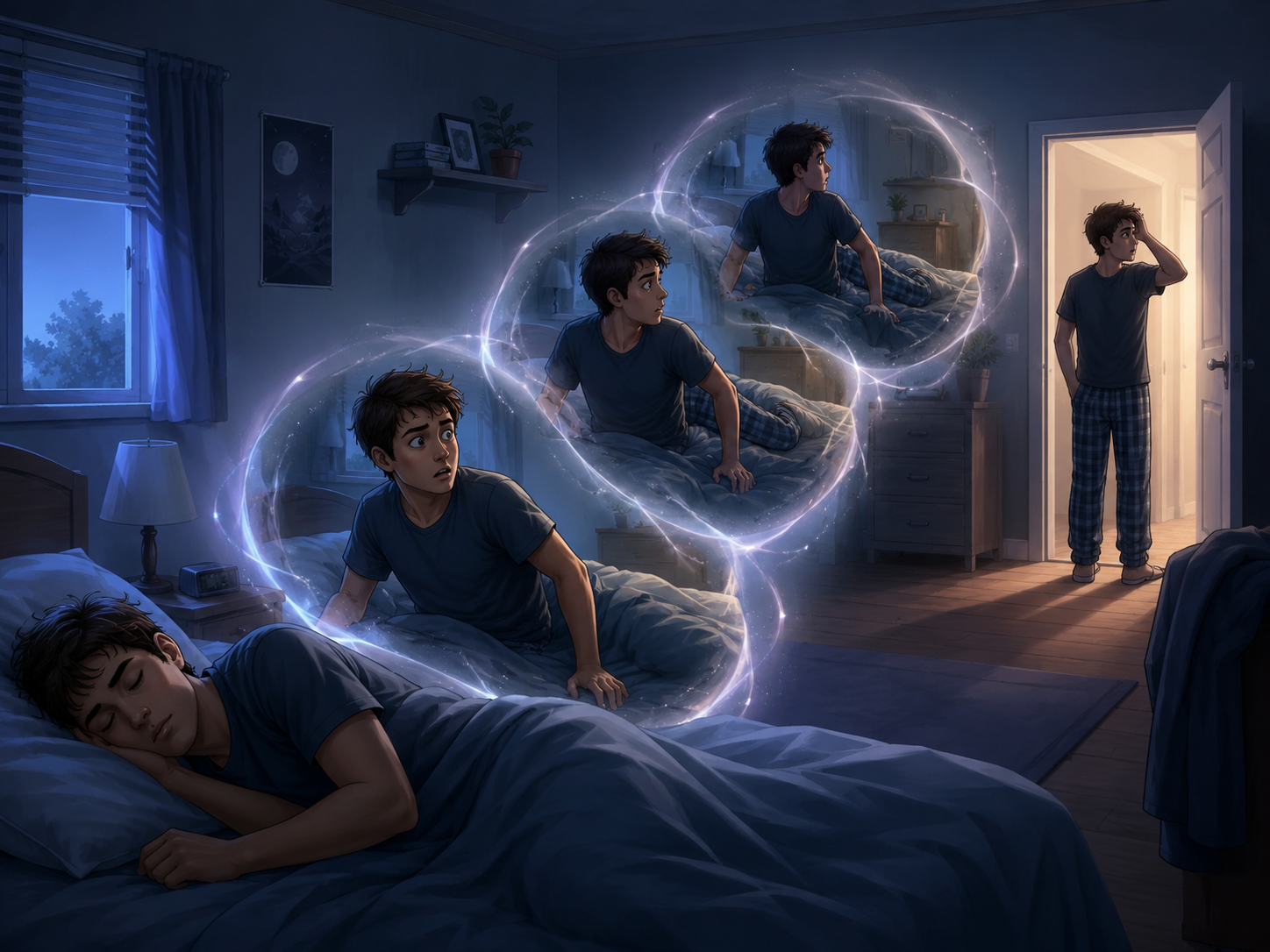
Imagine waking up in the morning, getting out of bed, checking your phone, and starting your usual routine.
Then you suddenly wake up again.
Only this time, you realize the first awakening never happened.
You were dreaming the entire time.
This experience is known as a false awakening, and it is more common than many people realize.
Although false awakenings can feel strange or even unsettling, they are generally considered a normal dream phenomenon. Most people experience at least one false awakening at some point in their lives, often without knowing there is a name for it.
The experience becomes especially memorable because it feels so realistic. Unlike many ordinary dreams, false awakenings often take place in familiar environments and involve routine activities, making them difficult to distinguish from genuine wakefulness.
Quick Answer
A false awakening is a dream in which you believe you have woken up, even though you are still asleep. The experience often feels highly realistic and may involve everyday activities such as getting out of bed, checking the time, or starting your morning routine. False awakenings are generally harmless and commonly occur alongside vivid dreams and lucid dreams.
What Happens During a False Awakening?
During a false awakening, the brain creates a convincing simulation of waking up.
The dream may begin in your bedroom and closely resemble your actual surroundings. You may see familiar objects, hear expected sounds, and perform ordinary tasks that you would normally do after waking.
Because the scenario feels so familiar, most people accept it as reality without questioning it.
Only later do they realize they were still dreaming.
In some cases, the person wakes up for real and immediately recognizes what happened. In other cases, the false awakening continues into another dream sequence before true awakening occurs.
Why Do False Awakenings Feel So Real?
One reason false awakenings feel convincing is that they involve familiar settings and predictable routines.
Many dreams contain bizarre events that make it obvious something unusual is happening. False awakenings work differently. Instead of creating an entirely new environment, the dream reproduces one that the brain already knows extremely well.
Researchers also believe that false awakenings may occur during periods of heightened awareness within sleep, particularly when the brain is already moving toward wakefulness.
The result is a dream that combines elements of both dreaming and waking experience, creating an unusually realistic impression.
Are False Awakenings Related to Lucid Dreaming?
Yes, there appears to be a connection.
Many lucid dreamers report experiencing false awakenings more frequently than average. This may be because lucid dreamers spend more time thinking about dreams, waking up, and recognizing dream states.
A false awakening can sometimes become a lucid dream if the dreamer notices something unusual and realizes they are still asleep.
For example, someone may dream that they have awakened and begun their morning routine. While looking around, they notice that a clock displays impossible numbers or that something in the room seems out of place. This realization can trigger lucidity, allowing the person to recognize that the experience is still a dream.
Because of this relationship, false awakenings are often discussed within the broader topic of lucid dreaming.
Can You Have Multiple False Awakenings?
Yes.
Some people experience what are sometimes called nested false awakenings.
In these situations, the dreamer appears to wake up repeatedly, only to discover that each awakening was itself part of a dream.
This can create a confusing experience in which a person feels trapped in a cycle of waking up over and over again.
Although the experience may feel intense, it remains a dream phenomenon rather than a sign of anything dangerous. Eventually, the normal sleep cycle continues and genuine awakening occurs.
The experience may feel longer or more dramatic than it actually was because dream time can be perceived differently from waking time.
Are False Awakenings Dangerous?
For most people, no.
False awakenings are generally considered harmless and do not indicate a medical problem.
They are best understood as an unusual variation of normal dreaming rather than a sleep disorder.
The main effect is often psychological. Because the experience feels realistic, some people wake up feeling confused or unsettled for a short period of time.
This confusion typically resolves quickly once the person becomes fully awake and recognizes what happened.
False Awakening vs Sleep Paralysis
False awakenings and sleep paralysis are often confused, but they are different experiences.
A false awakening occurs while a person is still dreaming. The individual believes they have awakened even though sleep continues.
Sleep paralysis occurs when a person becomes conscious while temporary REM-related muscle paralysis is still present. During this period, the person is awake but unable to move voluntarily.
Both experiences can feel unusual and may occur around the transition between sleep and wakefulness. However, they involve different mechanisms and should not be considered the same phenomenon.
What Should You Do If It Happens?
In most cases, nothing.
False awakenings are generally harmless and do not require treatment.
If they occur occasionally, they are usually considered a normal part of dreaming. People who experience them frequently may find it helpful to improve sleep habits, reduce stress, and maintain a consistent sleep schedule, although research has not identified a guaranteed method for preventing them.
For individuals interested in lucid dreaming, false awakenings can even become opportunities to recognize the dream state and gain awareness while still asleep.
Bottom Line
A false awakening is a dream in which you believe you have woken up even though you remain asleep. Because these dreams often occur in familiar environments and involve ordinary routines, they can feel remarkably realistic.
Although false awakenings may be surprising or confusing, they are generally harmless and are often associated with vivid dreams and lucid dreaming. In some cases, they can even serve as a gateway to becoming lucid within a dream.
The most important thing to remember is that a false awakening is not a sign that something is wrong. It is simply one of the many fascinating ways the sleeping brain can blur the boundary between dreaming and waking experience.