

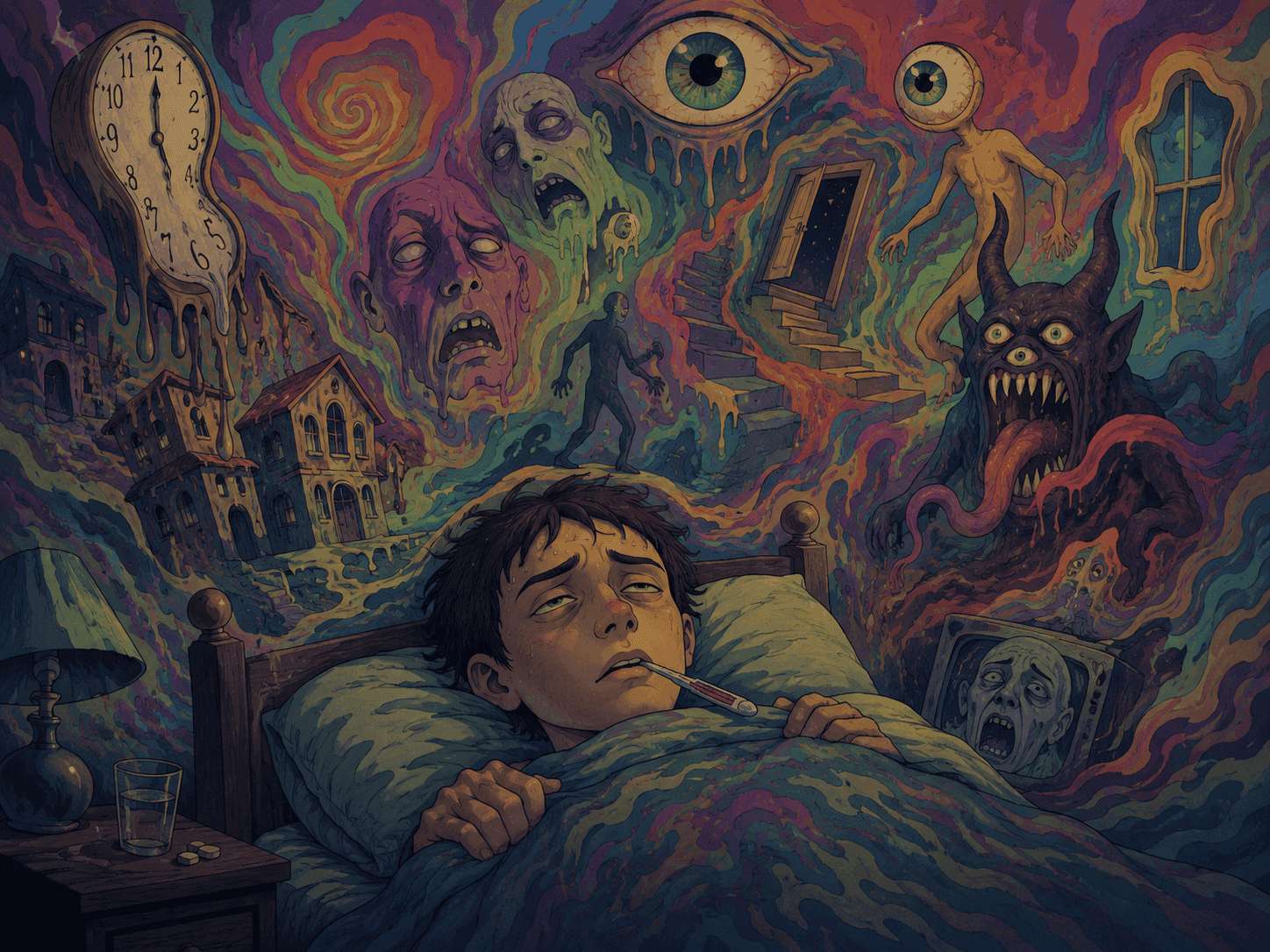
Most people who have experienced a fever dream remember one thing about it: it felt different from an ordinary dream.
The dream may have been unusually vivid, intensely emotional, bizarre, confusing, or even frightening. Some people describe fever dreams as surreal experiences that blur the boundary between dreaming and reality. Others recall strange visual distortions, impossible situations, or overwhelming feelings that seem far more intense than those found in typical dreams.
Because fever dreams are so memorable, many people wonder whether they represent a special type of dreaming.
The answer is both yes and no.
A fever dream is not a separate sleep stage or a medically distinct category of dream. Instead, the term generally refers to unusually vivid, strange, or emotionally intense dreams that occur while a person has a fever.
Although researchers are still studying the exact mechanisms involved, evidence suggests that elevated body temperature, disrupted sleep, immune system activity, and changes in brain function during illness may all contribute to the experience.
Understanding fever dreams offers an interesting glimpse into the relationship between physical health, sleep, and the dreaming brain.
Quick Answer
A fever dream is an unusually vivid, strange, or emotionally intense dream that occurs while a person has a fever. Fever dreams often feel more realistic, confusing, or disturbing than ordinary dreams and may be influenced by elevated body temperature, disrupted sleep, immune system activity, and changes in brain function associated with illness.
What Is a Fever Dream?
The term fever dream is commonly used to describe dreams that occur during an illness involving an elevated body temperature.
These dreams are often remembered because they feel unusually intense.
People frequently report experiences such as:
- Distorted environments.
- Strange visual imagery.
- Repetitive scenarios.
- Feelings of confusion.
- Anxiety or fear.
- A sense that events are simultaneously realistic and impossible.
Importantly, there is no single type of fever dream.
The content can vary dramatically between individuals.
Some fever dreams involve bizarre stories.
Others contain vivid nightmares.
Still others feel more like fragmented hallucinations than traditional dreams.
What unites them is the subjective feeling that the dream is unusually powerful or strange compared with normal dreaming.
Why Do Fever Dreams Feel So Different?
One of the most consistent observations about fever dreams is their intensity.
Many people report that fever dreams feel more vivid and emotionally charged than ordinary dreams.
Researchers believe several factors may contribute.
When the body develops a fever, physiological changes occur throughout the body and brain. These changes affect sleep quality, brain activity, temperature regulation, and immune responses.
At the same time, illness often causes fragmented sleep. A person may wake repeatedly during the night, drift in and out of sleep, and spend more time in lighter sleep stages.
This combination can make dream experiences easier to remember.
The brain may also process sensory information differently during illness, potentially contributing to the unusual quality of fever dreams.
Although scientists do not yet have a complete explanation, the evidence suggests that fever dreams arise from the interaction of multiple biological processes rather than a single cause.
What Causes Fever Dreams?
Researchers continue investigating the precise mechanisms involved, but several factors appear likely to contribute.
Elevated Body Temperature
Body temperature plays an important role in normal sleep regulation.
During healthy sleep, body temperature gradually decreases.
A fever disrupts this process.
The resulting changes may influence how the brain functions during sleep and dreaming.
Some researchers believe elevated temperature may contribute directly to the unusual sensory and emotional experiences associated with fever dreams.
Disrupted Sleep
Illness rarely produces ideal sleep conditions.
People with fevers often experience:
- Restlessness.
- Frequent awakenings.
- Sweating.
- Chills.
- Physical discomfort.
Because dream recall is more likely when sleep is interrupted, fragmented sleep may make fever dreams easier to remember.
Immune System Activity
When the body fights infection, the immune system releases signaling molecules known as cytokines.
These molecules help coordinate the body’s response to illness.
Researchers have found that immune activity can influence sleep patterns and brain function, suggesting another possible pathway through which illness affects dreaming.
Changes in Brain Function
Illness can affect attention, cognition, perception, and awareness during waking life.
Many people feel mentally foggy when they have a high fever.
Similar changes may influence dream experiences during sleep, contributing to the unusual quality of fever dreams.
Are Fever Dreams the Same as Nightmares?
Not necessarily.
There is considerable overlap, but the two are not identical.
A nightmare is generally defined as a frightening dream that causes distress and often wakes the dreamer.
A fever dream, by contrast, refers specifically to a dream occurring during illness and fever.
Some fever dreams are nightmares.
Others are not.
A fever dream may be:
- Frightening.
- Bizarre.
- Confusing.
- Surreal.
- Emotionally intense.
The defining feature is not fear but the connection to fever and illness.
This distinction helps explain why people sometimes describe fever dreams as strange rather than scary.
Common Themes Reported in Fever Dreams
Although fever dreams vary widely, researchers and clinicians have noted recurring themes in many reports.
People often describe experiences involving distortion.
Objects may seem too large or too small.
Spaces may expand or contract.
Distances may feel impossible to judge.
Others report repetitive patterns, endless loops, overwhelming pressure, or situations that feel simultaneously familiar and alien.
Interestingly, these themes resemble some of the perceptual distortions that can occur during illness and sleep disruption.
The consistency of these reports suggests that fever dreams may reflect common changes in how the brain processes information while sick.
Why Children Often Experience Fever Dreams
Parents frequently report that children experience unusual dreams during illnesses.
This is not surprising.
Children generally spend more time in REM sleep than adults and may be particularly sensitive to disruptions caused by fever.
In addition, children often have difficulty distinguishing between dreams and reality immediately after waking.
As a result, a vivid fever dream may feel especially real and upsetting.
Most fever dreams in children are temporary and resolve as the illness improves.
However, caregivers should always monitor severe confusion, persistent hallucinations, or unusual neurological symptoms and seek medical advice when appropriate.
Can a Fever Cause Hallucinations?
One reason fever dreams can feel so unsettling is that they sometimes resemble hallucinations.
People may wake up uncertain whether they were dreaming, awake, or somewhere in between. They may briefly believe that something from the dream is still present in the room or struggle to separate dream content from reality immediately after waking.
In most cases, fever dreams and hallucinations are not the same thing.
A fever dream occurs during sleep.
A hallucination occurs while awake and involves perceiving something that is not actually present.
However, the boundary can occasionally become blurred, particularly when a person is repeatedly waking and falling back asleep while ill. Sleep deprivation, elevated body temperature, and illness-related confusion can all contribute to unusual perceptual experiences.
In children, high fevers sometimes cause temporary confusion or disorientation that may be described as hallucination-like. Adults can experience similar symptoms when fevers become severe.
For this reason, persistent hallucinations, extreme confusion, or significant changes in mental status should always be taken seriously and evaluated by a healthcare professional.
Are Fever Dreams Dangerous?
The dreams themselves are generally not dangerous.
A fever dream is usually a symptom of the underlying illness rather than a condition in its own right.
Most fever dreams disappear once the fever resolves and normal sleep patterns return.
The primary concern is not the dream itself but what may be causing the fever.
Common viral infections, influenza, COVID-19, and many other illnesses can temporarily affect sleep quality and contribute to vivid dreaming.
In most healthy individuals, fever dreams are simply an unpleasant but temporary part of being sick.
However, if a fever is unusually high, persists for an extended period, or is accompanied by severe neurological symptoms, medical evaluation may be necessary.
The dream is rarely the problem.
The focus should remain on the illness that triggered it.
Why Do Fever Dreams Feel So Real?
Many people report that fever dreams feel more realistic than ordinary dreams.
Even years later, they may remember specific scenes, emotions, or sensations with unusual clarity.
Several factors may help explain this phenomenon.
First, fever dreams are often emotionally intense. Experiences associated with strong emotions tend to be remembered more easily than neutral experiences.
Second, illness frequently disrupts sleep. Because dream recall is most likely when a person wakes during or immediately after a dream, repeated awakenings can significantly increase memory retention.
Third, fever dreams often contain unusual imagery or bizarre scenarios that stand out from ordinary dream experiences. The brain tends to remember novel experiences more readily than routine ones.
Together, these factors may explain why many people remember fever dreams long after they have forgotten countless ordinary dreams.
What Happens to REM Sleep During Illness?
Researchers continue studying how illness affects sleep architecture, but evidence suggests that fever and infection can influence both REM sleep and non-REM sleep.
During illness, sleep often becomes more fragmented. People may wake more frequently, experience discomfort, and spend less time in uninterrupted sleep cycles.
Changes in REM sleep have been observed during various infections and inflammatory states, although the exact effects vary depending on the illness and the individual.
Because REM sleep is closely associated with vivid dreaming, disruptions to REM patterns may contribute to the unusual nature of fever dreams.
Researchers also believe that immune system activity may interact with sleep-regulating systems in the brain, creating conditions that alter dream experiences.
Although the precise mechanisms remain under investigation, fever dreams appear to reflect a complex interaction between illness, sleep disruption, body temperature, and brain activity.
Why Do Some Fever Dreams Feel Repetitive?
A common feature reported in fever dreams is repetition.
Some people describe the same scene repeating endlessly.
Others experience a sensation of being trapped in a loop, unable to complete a task or move beyond a particular event.
This phenomenon has been described in personal accounts for decades.
Researchers do not yet know exactly why repetitive dream patterns occur during illness, but they may be related to altered cognitive processing during fever and fragmented sleep.
When the brain is operating under conditions of stress, discomfort, and disrupted sleep, dream narratives may become less coherent and more repetitive than usual.
The result can be a dream that feels both intensely vivid and strangely stuck.
For many people, these looping experiences become one of the most memorable aspects of fever dreams.
When Should You Seek Medical Attention?
Most fever dreams are harmless and resolve as the underlying illness improves.
However, certain symptoms should never be dismissed simply as unusual dreaming.
Medical attention may be appropriate if fever is accompanied by:
- Severe confusion.
- Persistent hallucinations while awake.
- Difficulty remaining conscious.
- Seizures.
- Severe headache.
- Neck stiffness.
- Difficulty breathing.
- Signs of dehydration.
These symptoms may indicate a condition that requires prompt medical evaluation.
The presence of a fever dream alone is usually not a cause for concern, but significant neurological symptoms should always be taken seriously.
What Science Still Doesn’t Know
Despite how common fever dreams are, researchers still have much to learn about them.
Scientists understand that fever, sleep disruption, immune activity, and brain function all appear to play important roles. What remains unclear is precisely how these factors interact to produce the unusually vivid and often surreal experiences people describe.
Researchers continue investigating questions such as:
Why do some people experience fever dreams while others do not?
Why do certain themes, such as repetition and distortion, appear so frequently?
Why are some fever dreams remembered for years while others disappear immediately?
What specific changes occur within dreaming brain networks during illness?
These questions highlight how much remains unknown about the relationship between physical illness and dreaming.
DreamDoze Perspective
At DreamDoze, we view fever dreams as one of the clearest examples of how closely physical health and dreaming are connected.
Dreams are often discussed as purely psychological experiences, but fever dreams demonstrate that the body can influence the content and intensity of dreams in powerful ways. Changes in temperature, immune activity, sleep quality, and brain function all appear capable of shaping what we experience during sleep.
Although fever dreams can feel alarming, they are usually a temporary consequence of illness rather than a sign of something deeper or more mysterious.
Perhaps the most remarkable aspect of fever dreams is not that they occur, but how vividly they reveal the connection between the sleeping mind and the physical body.
Frequently Asked Questions
What is a fever dream?
A fever dream is an unusually vivid, strange, or emotionally intense dream that occurs while a person has a fever.
Are fever dreams real dreams?
Yes. Fever dreams are genuine dream experiences, although they often feel more vivid or unusual than ordinary dreams.
Why are fever dreams so weird?
Researchers believe elevated body temperature, disrupted sleep, immune system activity, and changes in brain function may all contribute to the unusual nature of fever dreams.
Can adults have fever dreams?
Absolutely. Although fever dreams are often discussed in relation to children, adults can experience them as well.
Do fever dreams mean the fever is dangerous?
Not necessarily. Fever dreams commonly occur during ordinary illnesses. The dream itself is usually not dangerous, although severe neurological symptoms should be evaluated by a healthcare professional.
Bottom Line
A fever dream is an unusually vivid or emotionally intense dream that occurs during an illness involving a fever. While the exact mechanisms remain under investigation, researchers believe that elevated body temperature, disrupted sleep, immune system activity, and changes in brain function all contribute to the experience.
Unlike ordinary dreams, fever dreams often feel exceptionally realistic, strange, repetitive, or emotionally powerful. These characteristics can make them memorable long after the illness has passed.
Although fever dreams can be unsettling, they are usually temporary and resolve as the underlying illness improves. Rather than representing a separate type of dreaming, they offer a fascinating example of how physical health can influence the experiences we have while asleep.