

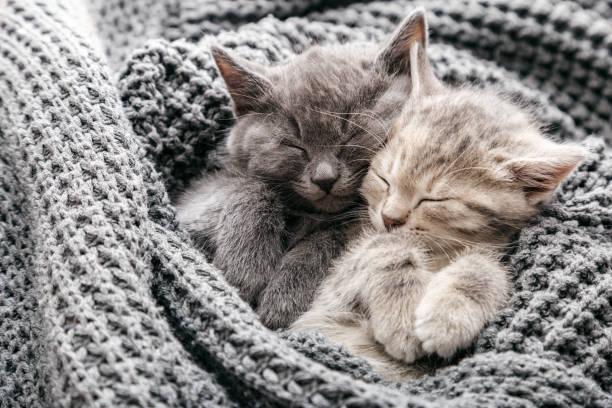
A sleeping cat suddenly twitches its whiskers. Its paws begin moving slightly. The ears flick. Sometimes the tail sways gently, as though responding to something invisible.
For many pet owners, these behaviors raise an intriguing question:
What is happening inside a cat’s mind while it sleeps?
More specifically, do cats dream?
And if they do, what might those dreams be about?
Although scientists cannot directly ask cats about their dream experiences, decades of research into sleep and animal behavior suggest that cats almost certainly experience dream-like states. Studies have shown that cats pass through stages of sleep that closely resemble those found in humans, including REM (Rapid Eye Movement) sleep, the stage most strongly associated with vivid dreaming.
What remains unknown is the exact content of those dreams.
Researchers cannot determine whether a cat dreams about chasing birds, exploring the house, interacting with other animals, or something entirely different. However, evidence from neuroscience and animal sleep research provides valuable clues about what may be occurring inside the sleeping feline brain.
Understanding how cats sleep and dream not only tells us more about our pets—it also offers fascinating insights into the evolutionary origins of dreaming itself.
Quick Answer
Scientists believe cats likely experience dream-like states during REM sleep. While no one can know exactly what cats dream about, researchers suspect their dreams may involve experiences from daily life, such as hunting, exploring, playing, interacting with people, or responding to familiar environments. This conclusion is based on observations of sleep behavior and similarities between feline and human sleep patterns.
Do Cats Dream?
Most sleep researchers believe the answer is yes.
Cats experience sleep cycles that include REM sleep, a stage strongly associated with dreaming in humans.
During REM sleep, brain activity increases significantly compared with other sleep stages. In many mammals, this stage is accompanied by rapid eye movements, muscle twitches, and changes in brain activity that suggest complex neurological processing.
Researchers have observed these patterns in cats for decades.
Because dreaming appears closely linked to REM sleep across many mammalian species, scientists generally consider it highly likely that cats experience some form of dreaming.
What remains uncertain is the subjective experience itself.
While researchers can measure brain activity and observe behavior, they cannot determine exactly what a cat experiences internally.
Nevertheless, the evidence strongly suggests that sleep in cats involves more than simple unconsciousness.
How Do Scientists Know Cats Probably Dream?
One of the most influential discoveries came from sleep research conducted in the twentieth century.
Scientists studying animal sleep observed that cats displayed many of the same physiological changes seen in sleeping humans.
During REM sleep, cats often exhibit:
- Rapid eye movements beneath closed eyelids.
- Small muscle twitches.
- Changes in breathing patterns.
- Increased brain activity.
Researchers also discovered that certain brain mechanisms normally prevent animals from physically acting out their dreams.
In experiments where these mechanisms were altered, sleeping cats sometimes appeared to perform behaviors resembling hunting, stalking, or exploring while remaining asleep.
These observations provided some of the strongest evidence that cats may be experiencing internally generated dream scenarios rather than merely resting.
Although such studies cannot reveal dream content directly, they suggest that meaningful neurological activity is occurring during sleep.
What Might Cats Dream About?
This is where science becomes more speculative.
No study can currently determine the exact content of a cat’s dreams.
However, researchers often draw inferences from what is known about dreaming in humans and other mammals.
Human dreams frequently incorporate experiences from daily life.
Memories, emotions, environments, and recent events often reappear in altered forms during sleep.
If cats dream in a similar way, it is reasonable to suspect that their dreams may involve familiar experiences.
A cat’s daily life often includes:
- Exploring its environment.
- Watching birds.
- Chasing moving objects.
- Interacting with humans.
- Playing.
- Hunting behaviors.
- Responding to other animals.
Researchers therefore hypothesize that dream content may reflect activities that are important to the cat during waking life.
This does not mean a cat literally replays its day while asleep.
Rather, the brain may be processing experiences, memories, and learned behaviors in ways that resemble dreaming.
Why Do Cats Twitch While Sleeping?
Sleeping cats frequently twitch.
For many owners, this is one of the first signs that sparks curiosity about dreaming.
Small movements of the paws, whiskers, ears, or tail are especially common during REM sleep.
These movements are generally considered normal.
In humans, similar muscle activity sometimes occurs during dreaming. Researchers believe these brief twitches may reflect activity within motor systems of the brain.
Although most muscles remain largely inactive during REM sleep, small movements can still occur.
In cats, these twitches may represent the outward signs of ongoing neurological activity associated with dream-like states.
The behavior is usually harmless and should not be confused with seizures or other medical conditions.
Do Cats Dream About Hunting?
Among all proposed explanations, hunting is one of the most plausible.
Even domestic cats retain many behaviors inherited from their wild ancestors.
Stalking, pouncing, chasing, and tracking movement remain deeply embedded within feline behavior.
Because dreams often appear connected to significant waking experiences, many researchers suspect that hunting-related behaviors may feature prominently in feline dreams.
This idea is partly supported by experimental observations in which sleeping cats displayed movements resembling stalking or pursuit behaviors.
Of course, scientists cannot confirm that a twitching paw means a cat is dreaming about a mouse.
However, hunting-related activities likely occupy an important place within the feline brain and therefore represent a reasonable possibility.
Do Kittens Dream More Than Adult Cats?
Research suggests that young mammals generally spend more time in REM sleep than adults, and cats appear to follow a similar pattern.
Kittens sleep for much of the day, often far more than adult cats. A significant portion of that sleep is believed to involve REM sleep, the stage most strongly associated with dreaming. This has led researchers to speculate that kittens may experience dream-like activity more frequently than mature cats.
One possible explanation relates to brain development.
During early life, the brain undergoes rapid growth and must process enormous amounts of new information. Young animals are constantly learning about their environment, developing motor skills, and forming memories. REM sleep may play an important role in supporting these developmental processes.
Although scientists cannot determine exactly what kittens experience while dreaming, their sleep patterns suggest that dreaming may be especially important during the earliest stages of life.
Do Cats Have Nightmares?
If cats can dream, it is reasonable to wonder whether they can also experience nightmares.
Unfortunately, there is no definitive answer.
Researchers cannot directly assess the emotional content of an animal’s dream. However, many scientists believe that if animals experience dream-like states, negative dream experiences are at least theoretically possible.
Anyone who has observed a sleeping cat suddenly vocalizing, twitching intensely, or appearing distressed has likely wondered whether the animal was having a bad dream.
In most cases, there is no cause for concern. Brief movements and sounds during sleep are normal and do not necessarily indicate fear or distress.
However, because emotions appear to play an important role in animal behavior and memory, some researchers consider it plausible that unpleasant experiences could occasionally be reflected during dreaming, much as they are in humans.
At present, though, the idea remains speculative rather than proven.
What Happens in a Cat’s Brain During REM Sleep?
One reason scientists believe cats dream is that their brains undergo remarkable changes during REM sleep.
Although a sleeping cat appears peaceful from the outside, the brain can become surprisingly active. Brain-wave recordings show patterns that differ substantially from those seen during deep non-REM sleep.
In some respects, REM sleep resembles wakefulness more than other stages of sleep.
This discovery has been one of the strongest arguments in favor of animal dreaming. The sleeping brain is not simply shutting down. Instead, it remains highly active and appears to engage in complex neurological processes.
Researchers suspect these processes may involve memory consolidation, learning, emotional regulation, and potentially dream generation.
Interestingly, similar REM sleep patterns have been documented in many mammals. Dogs, for example, also display behaviors associated with dream-like states during sleep. If you’re curious about canine dreaming, see our guide on What Do Dogs Dream About?, which explores how sleep research compares between dogs and cats.
Do Cats Dream About Their Owners?
This is one of the most common questions pet owners ask.
The honest answer is that no one knows for certain.
However, there are reasons to believe owners may sometimes appear within a cat’s dream experiences.
Dreams in humans frequently draw upon familiar individuals and everyday interactions. If feline dreaming operates in a broadly similar manner, experiences that are important during waking life may also influence dream content.
For many domestic cats, owners play a central role in daily routines. They provide food, social interaction, comfort, play, and environmental stimulation.
Because of this, some researchers consider it plausible that humans occasionally feature within a cat’s dream-like experiences.
That does not necessarily mean cats dream about people in the same way humans dream about one another. Rather, familiar scents, voices, interactions, and routines may contribute to whatever internal experiences occur during sleep.
Can Cats Remember Their Dreams?
Another intriguing question concerns memory.
Humans occasionally remember dreams after waking, but whether cats retain dream memories remains unknown.
Scientists currently have no reliable way to determine whether an animal recalls a dream after awakening.
Some researchers suspect that animals may experience dream-related memory processes without consciously remembering dreams in the way humans often do.
Others argue that because many animals demonstrate sophisticated memory abilities, some form of dream recall may be possible.
At present, however, there is no scientific evidence that cats consciously remember dreams after waking.
The question remains one of the many mysteries surrounding animal consciousness.
What Animal Dream Research Reveals
The study of dreaming in animals has transformed scientific understanding of sleep.
For much of history, dreams were viewed as uniquely human experiences. Modern research has challenged that assumption.
Today, evidence suggests that many mammals experience REM sleep and exhibit behaviors consistent with dream-like neurological activity.
Studies involving cats, dogs, rodents, and other species have revealed striking similarities in sleep architecture across mammals. These similarities suggest that dreaming may have deep evolutionary roots.
Rather than being a uniquely human phenomenon, dreaming may represent a biological process shared across a wide range of species.
This possibility has important implications for how scientists think about memory, learning, emotion, and consciousness in animals.
What Science Still Doesn’t Know
Despite decades of research, many fundamental questions remain unanswered.
Scientists still do not know:
- What cats subjectively experience during dreams.
- Whether cats experience narratives similar to human dreams.
- Whether cats have emotional dreams.
- Whether cats remember dreams after waking.
- How dream content differs between individual cats.
The challenge is simple but profound.
Dreams are private experiences.
Even in humans, researchers can only study dreams through reports given after waking. Animals cannot provide those reports.
As a result, scientists must rely on brain activity, sleep behavior, and indirect evidence.
While the evidence strongly supports the existence of dream-like states in cats, the exact nature of those experiences remains beyond current scientific reach.
DreamDoze Perspective
At DreamDoze, we think the most fascinating aspect of feline dreaming is not the question of whether cats dream, but what their dreams reveal about the broader nature of consciousness.
Modern sleep research strongly suggests that dreaming is not uniquely human. Cats appear to experience complex sleep states involving active brain processes, REM sleep, and behaviors consistent with dream-like activity.
What remains uncertain is the content of those experiences.
Perhaps cats dream about stalking prey, exploring familiar spaces, interacting with other animals, or responding to their owners. Perhaps their dreams are entirely different from anything humans experience.
For now, the evidence supports a simple conclusion: when a sleeping cat twitches its whiskers, moves its paws, or flicks its tail, something interesting is likely happening inside the brain. Exactly what that experience feels like remains one of the most intriguing mysteries in animal sleep research.
Frequently Asked Questions
Do cats really dream?
Most researchers believe they do. Cats experience REM sleep and display sleep behaviors that strongly suggest dream-like neurological activity.
What do cats most likely dream about?
Scientists cannot know for certain, but many suspect dreams may involve familiar experiences such as exploring, hunting, playing, or interacting with their environment.
Do cats dream about their owners?
It is possible. Because owners are often an important part of a cat’s daily life, some researchers consider it plausible that familiar people occasionally influence dream content.
Can cats have nightmares?
There is no definitive evidence, but researchers generally consider it possible that animals may occasionally experience unpleasant dream-like states.
Why does my cat twitch while sleeping?
Small twitches, whisker movements, ear flicks, and paw movements are common during REM sleep and are generally considered normal.
Bottom Line
Although scientists cannot determine exactly what cats dream about, decades of sleep research strongly suggest that cats experience dream-like states during REM sleep. Their brains remain active, their bodies display characteristic sleep behaviors, and their sleep architecture closely resembles that of other mammals known to dream.
The most likely explanation is that feline dreams are connected in some way to everyday experiences, memories, learned behaviors, and interactions with their environment. Hunting, exploring, playing, and social interactions may all contribute to dream content.
While the precise nature of a cat’s dreams remains unknown, the evidence increasingly suggests that the sleeping feline brain is far more active and fascinating than it appears from the outside.