

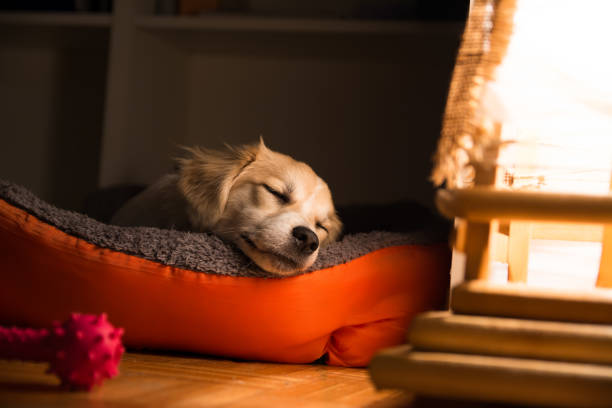
Many dog owners have witnessed the scene.
A sleeping dog suddenly begins moving its legs as if running. Its paws twitch. The ears shift slightly. Soft whimpers or barks sometimes escape while it remains asleep.
These behaviors often make it seem as though the dog is actively experiencing something in its mind.
The observation naturally raises a question that has fascinated both pet owners and scientists:
What do dogs dream about?
Although researchers cannot directly access a dog’s subjective experience, decades of sleep research strongly suggest that dogs experience dream-like states. Like humans, dogs cycle through different stages of sleep, including REM (Rapid Eye Movement) sleep, the stage most closely associated with vivid dreaming.
The challenge is determining what those dreams contain.
Scientists cannot ask a dog to describe a dream after waking. However, research into sleep, memory, learning, and animal behavior provides important clues. The evidence suggests that dogs may dream about experiences that are meaningful within their daily lives, much as humans often dream about events, emotions, and activities they encounter while awake.
Understanding what dogs may dream about offers a fascinating glimpse into the sleeping mind of one of humanity’s closest animal companions.
Quick Answer
Scientists believe dogs likely experience dream-like states during REM sleep. Although the exact content of canine dreams remains unknown, researchers suspect that dogs may dream about familiar activities such as playing, exploring, interacting with people, responding to other animals, and engaging in behaviors that are important to them during waking life.
Do Dogs Dream?
Most researchers believe they do.
The strongest evidence comes from sleep studies showing that dogs experience REM sleep, a stage associated with dreaming in humans and many other mammals.
During REM sleep, the brain becomes significantly more active than during deep non-REM sleep. At the same time, the body enters a state in which most voluntary muscles are temporarily inhibited, preventing the dreamer from physically acting out dream experiences.
Dogs display these same patterns.
Researchers have recorded REM sleep in dogs and observed physiological changes remarkably similar to those seen in humans. These findings strongly suggest that the canine brain remains active during sleep in ways consistent with dream-like experiences.
Although scientists cannot confirm exactly what a dog experiences internally, the evidence increasingly supports the conclusion that dogs do more than simply rest while asleep.
How Do Scientists Know Dogs Probably Dream?
Some of the most influential evidence comes from studies examining brain activity during sleep.
Researchers have found that dogs move through predictable sleep cycles involving both REM and non-REM sleep. During REM sleep, dogs often exhibit behaviors such as twitching, paw movements, changes in breathing patterns, and small vocalizations.
These observations alone do not prove dreaming.
However, additional evidence comes from research involving brain structures responsible for suppressing movement during REM sleep.
In classic animal sleep studies, researchers found that when certain REM-related inhibitory mechanisms were disrupted, sleeping animals sometimes appeared to physically enact behaviors associated with waking life. Dogs and other mammals might appear to run, chase, explore, or respond to imagined stimuli while remaining asleep.
These findings suggest that complex internal experiences may be occurring during REM sleep rather than simple unconscious inactivity.
What Might Dogs Dream About?
Although dream content cannot be measured directly, many researchers believe dreams likely draw upon experiences that are important during waking life.
In humans, dreams frequently incorporate memories, emotions, relationships, and recent events. A similar process may occur in dogs.
A typical dog’s daily experiences often include interacting with family members, exploring familiar environments, playing, learning routines, responding to sounds and scents, and engaging with other animals.
If canine dreaming functions similarly to human dreaming, these experiences could provide raw material for dream content.
Rather than replaying events exactly as they occurred, the brain may be processing memories and learned behaviors in ways that contribute to learning and memory consolidation.
For this reason, researchers often suspect that dreams may involve activities that are especially meaningful to the dog.
Do Dogs Dream About Their Owners?
Among pet owners, this is perhaps the most popular question.
While no one can provide a definitive answer, many scientists consider it plausible.
Humans frequently dream about people who play important roles in their lives. Because dogs form strong social bonds with their owners, researchers believe interactions with familiar humans may influence dream content.
From a dog’s perspective, owners are often associated with many of the most significant experiences of daily life. They provide companionship, play, food, comfort, routines, and social interaction.
Because of this, some researchers speculate that familiar people may occasionally appear within canine dream experiences, assuming dogs dream in ways broadly similar to other mammals.
However, it is important to recognize the limits of current knowledge. Scientists can reasonably infer possibilities, but they cannot confirm specific dream content.
Why Do Dogs Twitch While Sleeping?
One of the most visible signs of canine dreaming may be twitching.
Many dogs move their paws, legs, ears, or facial muscles while asleep. Some appear to run. Others make brief sounds or alter their breathing patterns.
These behaviors occur most commonly during REM sleep.
Researchers believe such movements reflect ongoing activity within motor regions of the brain. Although REM sleep normally suppresses most large muscle movements, small muscle groups may still activate.
The result is the familiar sight of a sleeping dog appearing to chase something, explore a new environment, or respond to events occurring within a dream-like state.
For healthy dogs, occasional twitching during sleep is generally considered normal.
Do Different Breeds Dream About Different Things?
Although no study can directly answer this question, some researchers believe breed-specific behaviors may offer clues.
Different breeds have been selectively developed for different purposes.
A Border Collie may spend much of its waking life responding to movement and herding behaviors.
A Labrador Retriever may engage heavily in retrieving and social interaction.
A scent hound experiences the world through extraordinary olfactory abilities.
If dreams are influenced by daily experiences and learned behaviors, it is reasonable to suspect that dream content may differ between individual dogs based on lifestyle, personality, training, and breed tendencies.
At present, however, this remains an informed hypothesis rather than a proven fact.
Do Puppies Dream More Than Adult Dogs?
Research suggests that young mammals generally spend a greater proportion of their sleep in REM sleep than adults, and dogs appear to follow this pattern.
Puppies sleep for much of the day, often between 18 and 20 hours depending on their age. During this period, the brain is developing rapidly. New experiences, environments, social interactions, and motor skills are constantly being processed.
Many sleep researchers believe REM sleep plays an important role in brain development and learning. Because puppies spend more time in REM sleep, they may experience dream-like activity more frequently than mature dogs.
Although scientists cannot determine what puppies dream about, it is reasonable to suspect that dreams may be connected to the enormous amount of learning that occurs during early life. A puppy encountering the world for the first time has far more new information to process than an adult dog following familiar routines.
Do Dogs Have Nightmares?
If dogs can dream, it is natural to wonder whether they can also have nightmares.
The honest answer is that no one knows with certainty.
Researchers cannot directly measure the emotional content of a dog’s dream. However, many scientists consider it plausible that dogs may occasionally experience unpleasant dream-like states.
Most dog owners have seen a sleeping dog suddenly whimper, growl, bark softly, or appear agitated. While these behaviors do not automatically indicate a nightmare, they suggest that emotionally significant activity may sometimes occur during sleep.
This possibility becomes even more interesting when considering that dogs clearly experience fear, anxiety, stress, and emotional memory while awake. If dreams are influenced by waking experiences, negative experiences could potentially influence dream content as well.
That said, owners should be cautious about assuming every twitch or vocalization indicates distress. Most sleep movements are considered normal parts of REM sleep.
What Happens in a Dog’s Brain During REM Sleep?
Although a sleeping dog may appear completely relaxed, significant neurological activity is taking place beneath the surface.
During REM sleep, brain activity increases substantially compared with deep non-REM sleep. Certain regions involved in memory, learning, and sensory processing become more active, while systems that suppress major muscle movements help keep the animal physically still.
This combination creates an intriguing situation.
The brain remains active and engaged, yet the body is largely prevented from acting out what is occurring internally.
Researchers believe this arrangement may support important functions related to memory processing and learning. It also provides one of the strongest pieces of evidence supporting the existence of dream-like experiences in dogs.
The sleeping brain is clearly doing more than simply resting.
Can Dogs Remember Their Dreams?
This remains one of the biggest unanswered questions in animal dream research.
Humans often remember dreams after waking, at least briefly. Whether dogs possess a similar ability is unknown.
Scientists currently have no reliable way to determine whether a dog consciously recalls a dream once it awakens.
Researchers do know that dogs possess sophisticated memory abilities. They can recognize familiar people, learn routines, remember locations, and respond to previous experiences. However, dream recall involves a different question: whether the contents of a dream remain accessible after sleep ends.
At present, there is no evidence that dogs remember dreams in the same way humans sometimes do. Equally, there is no evidence proving they do not.
The question remains open.
What Animal Dream Research Reveals
One of the most important developments in modern sleep science has been the growing recognition that dreaming may not be uniquely human.
Studies across numerous mammalian species have revealed surprisingly similar sleep architectures. REM sleep has been documented in dogs, cats, rodents, primates, and many other animals. In each case, researchers observe patterns of brain activity that suggest complex internal processing during sleep.
These findings have encouraged scientists to think about dreaming as a broader biological phenomenon rather than an exclusively human experience.
Dogs are not the only household pets believed to experience dream-like states. Similar REM sleep patterns have been observed in cats, leading researchers to draw many of the same conclusions about feline dreaming. For a closer look at how sleep research applies to cats, see our guide on What Do Cats Dream About?
Taken together, this body of research suggests that dreaming may have deep evolutionary roots that extend far beyond humans.
What Science Still Doesn’t Know
Despite decades of study, researchers continue to face significant limitations when investigating animal dreams.
The central challenge is straightforward: dreams are private experiences.
In humans, scientists can at least ask participants to describe what they remember after waking. With animals, that option does not exist.
As a result, researchers must rely on indirect evidence such as:
- Brain activity.
- Sleep stages.
- Behavioral observations.
- Physiological measurements.
These methods provide strong evidence that dogs experience dream-like states, but they cannot reveal the precise contents of those experiences.
Scientists still do not know:
- What dogs subjectively experience while dreaming.
- Whether dreams contain narratives similar to human dreams.
- Whether dogs experience symbolic dream content.
- How emotional dream experiences may differ between individual animals.
Future advances in neuroscience may provide additional clues, but many aspects of animal dreaming are likely to remain mysterious for some time.
DreamDoze Perspective
At DreamDoze, we think one of the most fascinating aspects of canine dreaming is what it reveals about the continuity between human and animal minds.
Modern sleep research increasingly suggests that dreaming is not an isolated human phenomenon. Dogs appear to experience many of the same sleep stages, neurological processes, and behavioral signs associated with dreaming in people.
What remains unknown is the subjective experience itself.
A dog’s dream is unlikely to resemble a human dream in every respect. Dogs perceive the world differently, rely more heavily on scent, and experience their environment through sensory systems that differ from our own. Whatever occurs during canine dreaming is therefore likely shaped by a uniquely canine perspective.
Even so, the evidence suggests that the sleeping dog is not simply unconscious. The brain remains active, memories may be processed, and dream-like experiences may unfold behind closed eyes.
Frequently Asked Questions
Do dogs really dream?
Most sleep researchers believe they do. Dogs experience REM sleep and display physiological patterns strongly associated with dreaming in mammals.
What do dogs most likely dream about?
Scientists cannot know for certain, but many suspect dreams may involve familiar experiences such as playing, exploring, interacting with owners, responding to scents, or engaging in breed-specific behaviors.
Do dogs dream about their owners?
It is possible. Because owners are often central figures in a dog’s daily life, many researchers consider it plausible that interactions with familiar people may influence dream content.
Can dogs have nightmares?
Researchers cannot confirm this directly, but many believe unpleasant dream-like experiences are possible if dogs dream in ways similar to humans.
Why does my dog move while sleeping?
Small movements, paw twitches, ear flicks, and vocalizations commonly occur during REM sleep and are usually considered normal.
Bottom Line
Evidence from sleep research strongly suggests that dogs experience dream-like states during REM sleep. Their brains remain active, their sleep patterns resemble those of other dreaming mammals, and their behavior during sleep often reflects complex neurological activity.
Although scientists cannot determine exactly what dogs dream about, the most likely explanation is that dreams are influenced by experiences that matter during waking life. Social interactions, exploration, learning, play, and familiar routines may all contribute to dream content.
While the inner world of a dreaming dog remains largely hidden from scientific observation, modern research increasingly supports the idea that canine sleep involves far more than simple rest. Behind those twitching paws and softly moving ears, the sleeping brain may be engaged in experiences that are surprisingly rich and complex.