

For decades, most people were taught a simple explanation about dreaming:
Dreams happen during REM sleep.
While that statement is partly true, modern sleep research has revealed a much more interesting picture.
Dreaming is closely associated with REM (Rapid Eye Movement) sleep, and some of the most vivid, emotional, and memorable dreams occur during this stage. However, scientists now know that dreaming is not limited to REM sleep alone.
People can dream during multiple stages of sleep.
The nature of those dreams may change depending on the stage, but the sleeping brain appears capable of generating dream experiences throughout much of the night.
Understanding when dreams occur requires understanding how sleep itself works.
Sleep is not a single state.
Instead, it is a dynamic cycle that moves through several stages, each associated with distinct patterns of brain activity, memory processing, physical recovery, and dream experiences.
By understanding these stages, we can better understand why some dreams feel vivid and cinematic while others are brief, fragmented, or quickly forgotten.
Quick Answer
Most vivid and memorable dreams occur during REM (Rapid Eye Movement) sleep, which is the stage most strongly associated with dreaming.
However, research shows that dreaming can occur during both REM and non-REM sleep. Dreams during REM sleep tend to be more visual, emotional, and story-like, while dreams during non-REM sleep are often shorter, less vivid, and more thought-like.
Although dreaming can happen throughout the night, the dreams people remember most often come from REM sleep because REM periods become longer and more intense toward morning.
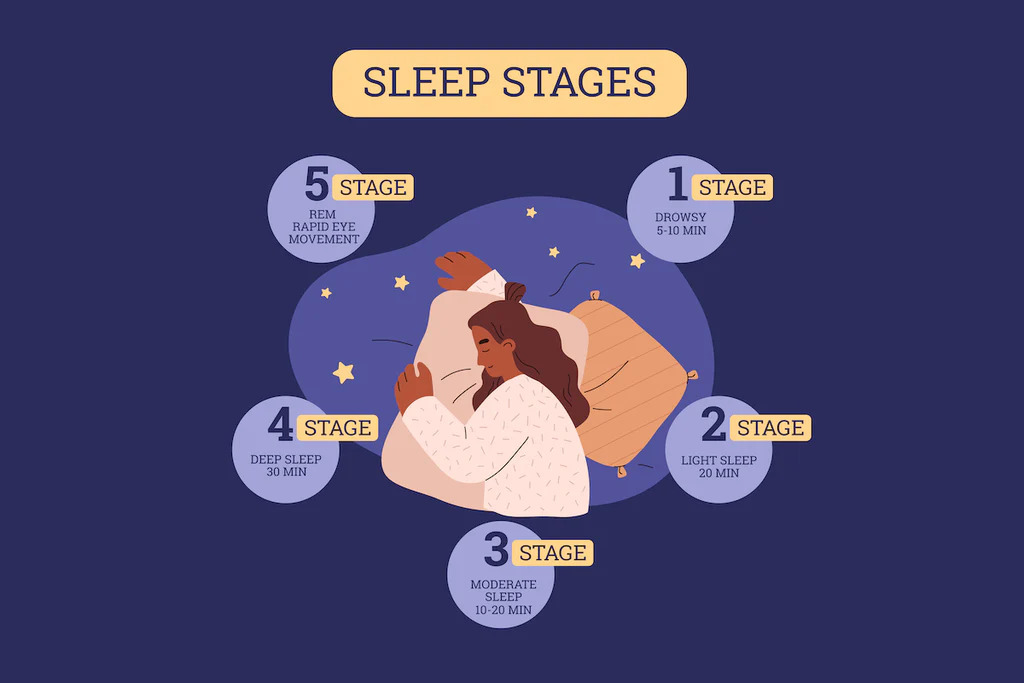
What Are the Stages of Sleep?
Sleep is divided into two broad categories:
- Non-REM sleep (NREM)
- REM sleep
Within non-REM sleep, researchers typically identify three stages:
- NREM Stage 1
- NREM Stage 2
- NREM Stage 3 (Deep Sleep)
These stages occur in a repeating cycle throughout the night.
A typical sleep cycle lasts approximately 90 minutes, although exact timing varies between individuals.
A simplified cycle looks like this:
- Stage 1
- Stage 2
- Stage 3
- Stage 2
- REM Sleep
The cycle then repeats multiple times before morning.
Each stage serves different biological functions and contributes differently to dreaming.
Stage 1 Sleep: The Transition Into Sleep
Stage 1 is the lightest stage of sleep.
It occurs during the transition from wakefulness to sleep and typically lasts only a few minutes.
During this stage:
- Brain activity begins slowing.
- Muscle activity decreases.
- Awareness of the environment fades.
- Hypnagogic experiences may occur.
Some people experience:
- Brief dream-like images.
- Sudden sensations of falling.
- Visual flashes.
- Auditory hallucinations.
These experiences are not usually considered full dreams.
Instead, they represent the brain’s transition into sleep.
Because Stage 1 is so brief, complex dream narratives are uncommon.
Stage 2 Sleep: Light Sleep and Early Dreaming
Stage 2 accounts for a significant portion of total sleep time.
Most adults spend more time in Stage 2 than any other sleep stage.
Brain activity continues slowing, but important memory-processing activity remains active.
Researchers have found that dream experiences can occur during Stage 2 sleep.
Compared with REM dreams, these experiences tend to be:
- Less vivid.
- Less emotional.
- Less visual.
- More thought-like.
Someone awakened during Stage 2 may report:
- Fragments of conversations.
- Isolated thoughts.
- Simple scenes.
- Brief mental images.
These experiences qualify as dreaming, but they usually lack the immersive quality associated with REM dreams.
Stage 3 Sleep: Deep Sleep and Dreaming
Stage 3 is often referred to as deep sleep or slow-wave sleep.
This stage plays an important role in:
- Physical recovery.
- Immune function.
- Tissue repair.
- Memory consolidation.
For many years, researchers assumed little dreaming occurred during deep sleep.
Modern evidence suggests otherwise.
Dream reports collected from individuals awakened during deep sleep indicate that dream experiences can occur even here.
However, these dreams often differ from REM dreams.
They are frequently:
- Simpler.
- Less visual.
- Less emotional.
- More focused on thoughts or concepts.
Dreaming during deep sleep appears less common than dreaming during REM sleep, but it is not absent.
This finding helped change the traditional view that dreaming belongs exclusively to REM sleep.
REM Sleep: The Stage Most Associated With Dreams
When most people think about dreaming, they are really thinking about REM sleep.
REM stands for Rapid Eye Movement.
This stage is characterized by:
- Increased brain activity.
- Rapid eye movements.
- Temporary muscle paralysis.
- Heightened emotional processing.
- Vivid dreaming.
Brain activity during REM sleep resembles wakefulness more closely than other sleep stages.
This heightened activity helps explain why REM dreams often feel realistic and immersive.
Many classic dream experiences occur during REM sleep, including:
- Elaborate stories.
- Strong emotions.
- Impossible events.
- Lucid dreams.
- Nightmares.
If someone is awakened directly from REM sleep, they are far more likely to report a detailed dream than if awakened from another stage.
Why REM Dreams Feel More Real
One reason REM dreams stand out is their sensory richness.
Compared with dreams from non-REM sleep, REM dreams typically contain:
- More visual detail.
- More characters.
- More movement.
- Stronger emotions.
- More complex storylines.
Researchers believe this may be related to increased activation in brain regions involved in emotion, memory, and visual processing.
At the same time, areas involved in critical thinking and logical evaluation become less active.
This helps explain why bizarre dream events often seem perfectly normal while they are occurring.
A person may accept impossible situations without question because the brain systems responsible for skepticism are operating differently during REM sleep.
How Often Does REM Sleep Occur?
REM sleep does not happen just once per night.
Instead, it appears repeatedly throughout sleep.
A typical adult experiences four to six REM periods each night.
Importantly, these REM periods become progressively longer.
A simplified example might look like:
- First REM period: 5–10 minutes
- Second REM period: 10–20 minutes
- Third REM period: 20–30 minutes
- Final REM periods: 30–60 minutes
This pattern helps explain why dreams just before waking are often:
- More vivid.
- More memorable.
- More detailed.
- More likely to be recalled.
Do You Dream in Every Stage of Sleep?
One of the most significant discoveries in modern sleep research is that dreaming is not limited to REM sleep.
For many years, scientists believed that REM sleep was the exclusive source of dreams.
Today, the evidence suggests a more nuanced reality.
Dream experiences can occur during:
- Stage 1 sleep
- Stage 2 sleep
- Stage 3 sleep
- REM sleep
What changes is the character of the dream.
Dream reports collected from REM sleep tend to be:
- Longer.
- More visual.
- More emotional.
- More narrative-driven.
Dream reports collected from non-REM sleep are often:
- Shorter.
- Less vivid.
- More thought-like.
- More fragmented.
A useful analogy is to think of dreaming as a spectrum rather than a switch.
The brain does not suddenly start dreaming only when REM sleep begins.
Instead, dream-like mental activity appears throughout much of the night, reaching its most vivid form during REM sleep.
Why Dreams Before Morning Feel Stronger
Many people notice that the dreams they remember best occur shortly before waking.
This observation is supported by sleep science.
As the night progresses, REM periods become progressively longer.
By the early morning hours, REM sleep can last 30 minutes, 45 minutes, or even longer.
These extended REM periods allow dreams to become:
- More elaborate.
- More immersive.
- More emotionally complex.
- Easier to remember.
Another factor involves timing.
Dream memories fade rapidly.
When a person wakes directly from a dream, the memory has a much better chance of surviving.
A dream that occurred six hours before waking may disappear entirely.
A dream that occurred moments before waking is far more likely to be recalled.
This combination of longer REM periods and immediate recall helps explain why morning dreams often feel especially vivid.
What Happens If You Don’t Get Enough REM Sleep?
Because REM sleep is strongly associated with dreaming, many people wonder what happens when REM sleep is reduced.
Several factors can suppress REM sleep, including:
- Sleep deprivation.
- Certain medications.
- Alcohol consumption.
- Sleep disorders.
- Irregular sleep schedules.
When REM sleep decreases, people often report:
- Reduced dream recall.
- Fewer vivid dreams.
- Less detailed dream memories.
However, the brain does not always accept this reduction passively.
In many cases, it attempts to compensate.
This phenomenon is known as REM rebound.
REM Rebound Explained
REM rebound occurs when the brain increases REM sleep following a period of REM deprivation.
Researchers have observed this effect in various situations, including:
- Sleep deprivation.
- Alcohol withdrawal.
- Discontinuation of certain medications.
- Recovery from disrupted sleep schedules.
During REM rebound:
- REM periods may become longer.
- Dream activity may become more intense.
- Dream recall often increases.
This helps explain why people sometimes experience unusually vivid dreams after finally getting a good night’s sleep following several poor nights.
The dreams may feel stronger because the brain is spending more time in REM sleep than usual.
Lucid Dreaming and REM Sleep
Lucid dreaming is most strongly associated with REM sleep.
Although researchers continue investigating the exact mechanisms involved, most documented lucid dreams occur during REM periods.
This makes sense when considering the characteristics of REM sleep.
REM dreams are typically:
- Highly immersive.
- Visually rich.
- Emotionally intense.
These qualities create an environment in which self-awareness can occasionally emerge.
During a lucid dream, the dreamer realizes:
“I’m dreaming.”
while remaining asleep.
Brain imaging studies suggest that certain regions involved in self-reflection and metacognition become more active during lucid dreams than during ordinary REM dreams.
This unusual combination of dreaming and awareness is one reason lucid dreaming remains one of the most fascinating topics in sleep science.
Nightmares and REM Sleep
Nightmares also have a strong connection to REM sleep.
Because REM dreams tend to be more emotional and immersive, they provide fertile ground for fear-based experiences.
Nightmares often involve:
- Threats.
- Pursuit.
- Danger.
- Loss.
- Anxiety-provoking situations.
The emotional intensity of REM sleep may contribute to the vividness of these experiences.
However, not every nightmare occurs during REM sleep.
Some sleep disorders can produce frightening experiences during non-REM sleep as well.
Examples include:
- Sleep terrors.
- Confusional arousals.
- Certain parasomnias.
Distinguishing between nightmares and other sleep-related experiences is one reason sleep researchers pay close attention to sleep stages.
Why Do Dreams Seem So Strange?
If dreaming serves useful functions such as memory processing and emotional regulation, why are dreams often so bizarre?
Researchers still debate this question.
Several theories exist.
Some suggest dreams reflect the brain’s attempt to organize memories and emotions.
Others propose that dreams arise from spontaneous neural activity that the brain later transforms into a story.
REM sleep may contribute to dream oddness because brain regions associated with logical reasoning become less active while emotional and visual regions remain highly engaged.
The result is a mental environment where unusual combinations of people, places, and events can seem perfectly normal.
Understanding this balance between emotion and logic helps explain why dreams can feel meaningful while simultaneously appearing absurd.
What Science Still Doesn’t Know
Sleep science has made enormous progress in understanding dreaming.
Yet important mysteries remain.
Researchers still do not fully understand:
- Why some dreams are remembered while others disappear.
- Why dreams vary so dramatically between individuals.
- The precise function of dreaming.
- Why certain dreams become recurring dreams.
- How dream narratives are constructed.
- Why consciousness behaves differently across sleep stages.
These unanswered questions continue to drive research into sleep, memory, and consciousness.
The fact that everyone dreams makes these mysteries particularly compelling.
Dreaming is one of the most universal human experiences, yet many aspects remain poorly understood.
DreamDoze Perspective
At DreamDoze, we believe one of the most important lessons from modern sleep science is that dreaming is not confined to a single stage of sleep.
The traditional statement:
“You dream during REM sleep.”
is partly correct.
A more accurate statement is:
“The most vivid and memorable dreams usually occur during REM sleep, but dreaming can happen throughout the night.”
This distinction matters because it reflects how sleep truly works.
Sleep is not a static state.
It is a dynamic cycle involving multiple stages, each contributing differently to recovery, memory, emotion, and dreaming.
Understanding these stages helps explain why dreams vary so dramatically—from fleeting fragments of thought to elaborate stories that feel almost as real as waking life.
Frequently Asked Questions
What stage of sleep do you dream the most?
Most vivid and memorable dreams occur during REM sleep.
However, dream experiences can occur during non-REM stages as well.
Do you only dream during REM sleep?
No.
Research suggests dreaming can occur in all sleep stages, although REM dreams tend to be more vivid and story-like.
Why are dreams more vivid before waking up?
REM periods become longer later in the night, and waking shortly after a dream makes it easier to remember.
Does deep sleep contain dreams?
Yes.
Dream experiences can occur during deep sleep, although they are often less vivid and less narrative-driven than REM dreams.
Are nightmares REM sleep dreams?
Most nightmares occur during REM sleep because REM is associated with vivid emotional dreaming.
Bottom Line
Dreaming is most strongly associated with REM sleep, which is why REM is often called the dream stage of sleep. During REM sleep, brain activity increases, emotions become more active, and dreams tend to be vivid, immersive, and memorable.
However, modern sleep research shows that dreaming is not exclusive to REM sleep. Dream experiences can occur throughout multiple stages of the sleep cycle, although they often differ in intensity and complexity.
Understanding the relationship between sleep stages and dreaming helps explain why some dreams feel like brief fragments while others unfold as elaborate stories. It also reveals a broader truth about sleep itself: dreaming is not a single event but an ongoing process that accompanies much of the night.