

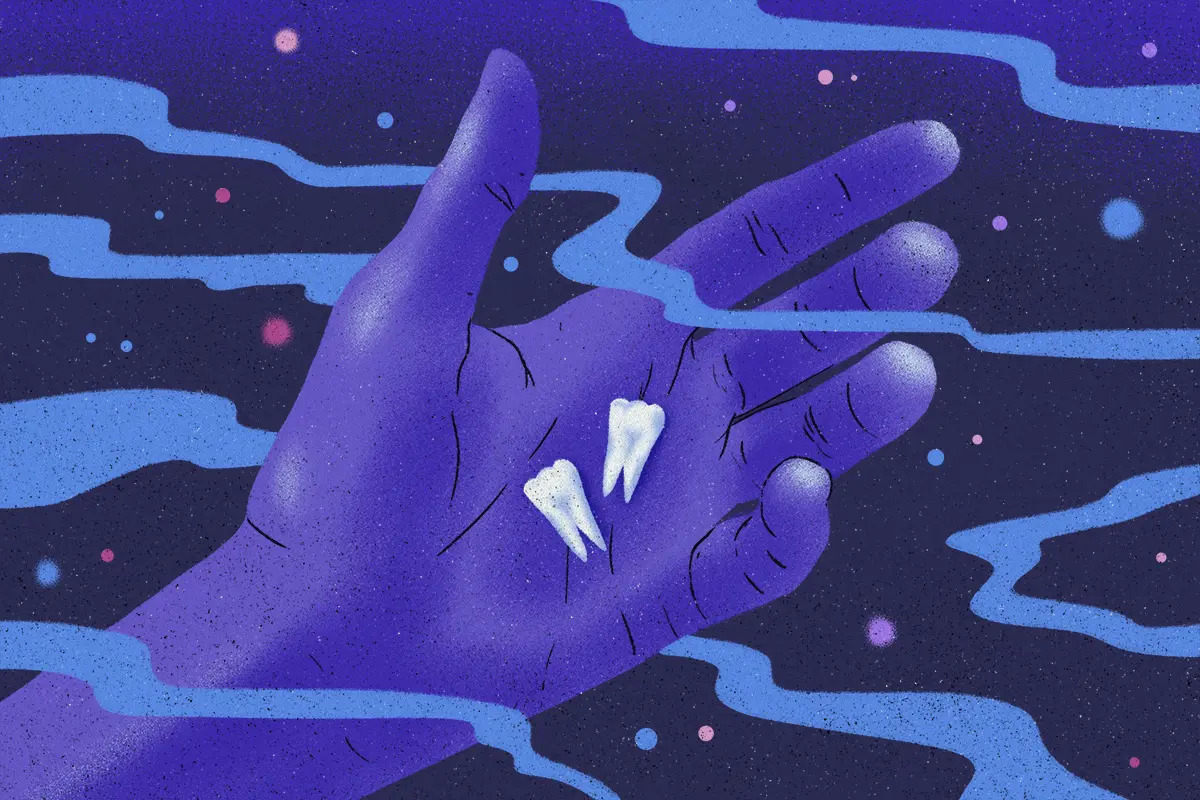
Few dreams are as unsettling—and as surprisingly common—as dreaming that your teeth are falling out.
Perhaps a single tooth becomes loose.
Maybe several teeth crumble in your hands.
Sometimes entire rows of teeth fall out while you’re speaking, eating, or looking in a mirror.
For many people, the dream feels intensely real. The sensation of loose teeth, the shock of seeing them fall, and the panic that follows often remain vivid long after waking.
Because the experience is so memorable, people frequently search for explanations.
Does the dream predict something bad?
Does it symbolize illness, loss, or major life changes?
Or is there another explanation entirely?
Dream researchers have been studying teeth-loss dreams for decades. While no single interpretation applies to everyone, psychologists, neuroscientists, and sleep researchers have identified several recurring themes that may help explain why these dreams occur.
Interestingly, modern research suggests that teeth-falling-out dreams may have less to do with the teeth themselves and more to do with the emotions, concerns, and experiences associated with them.
Quick Answer
Dreams about teeth falling out are commonly associated with stress, anxiety, insecurity, life transitions, loss of control, self-image concerns, and emotional uncertainty.
Some researchers also suggest that physical sensations such as teeth grinding, jaw tension, or dental irritation during sleep may contribute to these dreams.
There is no universally accepted meaning, and the interpretation depends heavily on the dreamer’s circumstances and emotional state.
Why Are Teeth Falling Out Dreams So Common?
Across cultures, languages, and age groups, dreams involving teeth are reported with remarkable frequency.
This has made them one of the most widely studied dream themes in psychological research.
One reason may be that teeth carry significant emotional importance.
They are connected to:
- Appearance.
- Communication.
- Eating.
- Health.
- Confidence.
- Aging.
Because teeth play such an important role in daily life, threats involving them naturally provoke strong emotional reactions.
Dreams often amplify emotions rather than reality.
As a result, concerns involving vulnerability, loss, embarrassment, or uncertainty may become symbolized through dramatic images such as teeth breaking, crumbling, or falling out.
The emotional response tends to be more important than the symbol itself.
The dream is often less about dental health and more about how the dreamer feels.
What Psychology Suggests About Teeth Falling Out Dreams
Modern psychology generally avoids assigning fixed meanings to dream symbols.
Instead, psychologists focus on emotional associations.
When people lose teeth in dreams, several themes frequently emerge.
Loss of Control
Many dreamers describe feeling helpless during the experience.
The teeth loosen unexpectedly.
They cannot stop them from falling out.
The situation feels beyond their control.
Because of this, some psychologists suggest that teeth-loss dreams may reflect situations in waking life where control feels limited.
Examples might include:
- Major life changes.
- Career uncertainty.
- Relationship difficulties.
- Financial pressure.
- Unexpected challenges.
The dream transforms those emotions into a vivid physical experience.
Anxiety and Stress
Stress is one of the most frequently discussed explanations.
Periods of heightened stress often coincide with an increase in vivid and emotionally charged dreams.
The sensation of teeth falling out can capture the feeling that something important is slipping away or becoming unstable.
This interpretation does not mean stress always causes the dream.
However, many people report teeth-loss dreams during particularly demanding periods of life.
Vulnerability and Insecurity
Teeth are closely linked to appearance and confidence.
For some individuals, dreams involving damaged or missing teeth may reflect concerns about how they are perceived by others.
These concerns may involve:
- Self-confidence.
- Public image.
- Social anxiety.
- Fear of embarrassment.
- Fear of judgment.
Again, the dream may be expressing an emotional reality rather than a literal concern about teeth.
Could Physical Causes Contribute?
One of the most interesting findings in dream research is that some teeth-loss dreams may have a physical component.
Unlike many dream symbols, teeth have direct sensory connections that remain active during sleep.
Researchers have proposed that conditions such as:
- Teeth grinding (bruxism).
- Jaw clenching.
- Dental discomfort.
- Oral irritation.
may occasionally influence dream content.
In these situations, the dream may partly reflect the brain’s attempt to interpret physical sensations occurring during sleep.
This does not explain every teeth-loss dream.
However, it offers an important reminder that dreams are influenced by both psychological and physiological factors.
Sometimes the body contributes to the story the mind creates.
Why Teeth Dreams Often Occur During Major Life Changes
Many people report teeth-loss dreams during periods of transition.
Examples include:
- Starting a new job.
- Ending a relationship.
- Becoming a parent.
- Moving to a new city.
- Entering a new stage of life.
Transitions often involve uncertainty.
Even positive changes can create anxiety because they require adaptation.
Some dream researchers suggest that teeth-loss dreams may symbolize the discomfort of moving from one stage of life to another.
In this sense, the dream is not necessarily about loss.
It may be about transformation.
Children lose teeth as part of development.
The symbolism of losing teeth therefore carries a natural association with change and growth.
For some dreamers, this symbolic connection may contribute to the dream’s emotional impact.
What If Your Teeth Crumble Instead of Falling Out?
Not all teeth-loss dreams unfold the same way.
In some dreams, the teeth do not simply fall out. Instead, they crack, shatter, crumble, or disintegrate into small pieces.
Many people find these dreams even more disturbing because the process feels gradual rather than sudden.
Psychologically, crumbling teeth may symbolize deterioration rather than loss.
The dream may reflect a situation that feels unstable, fragile, or increasingly difficult to maintain.
For example, a person experiencing ongoing stress might feel that their ability to cope is slowly eroding.
Someone facing relationship difficulties may feel that trust is gradually breaking down.
A professional challenge may create the sense that confidence is weakening over time.
The dream imagery mirrors the feeling that something important is not disappearing instantly but is instead slowly falling apart.
Importantly, the dream does not necessarily indicate that anything is actually deteriorating.
Rather, it may reflect how the situation feels from the dreamer’s perspective.
What If All Your Teeth Fall Out?
One of the most dramatic versions of this dream involves losing every tooth at once.
The emotional response is often intense.
Dreamers frequently describe feelings of shock, panic, embarrassment, vulnerability, or helplessness.
Because teeth are associated with speaking, eating, appearance, and confidence, losing all of them can symbolize a profound sense of exposure.
Some dream researchers suggest that large-scale tooth loss in dreams may occur when multiple stressors are present simultaneously.
Rather than representing a single concern, the dream may reflect a broader feeling that life has become overwhelming.
However, context remains critical.
For one person, the dream may be connected to anxiety.
For another, it may reflect a major life transition.
For someone else, it may simply be a vivid dream influenced by physical sensations during sleep.
The same imagery does not always carry the same meaning.
What If You Feel Calm in the Dream?
Many interpretations assume that teeth-loss dreams are frightening.
Yet some people report feeling surprisingly calm.
They notice their teeth falling out but experience little fear or distress.
This detail may significantly change the interpretation.
When fear is absent, the dream may be less about anxiety and more about acceptance.
The dreamer may be adapting to change rather than resisting it.
In some cases, the dream may symbolize letting go of an old identity, habit, relationship, or stage of life.
The emotional tone often provides a more useful clue than the dream symbol itself.
A frightening dream and a peaceful dream involving the same event may communicate entirely different emotional messages.
This is one reason DreamDoze emphasizes context over dream dictionaries.
The Connection Between Teeth Grinding and Teeth Dreams
One of the most intriguing explanations for teeth-loss dreams comes from sleep physiology rather than symbolism.
Some researchers have investigated whether teeth grinding, also known as bruxism, may contribute to dreams involving damaged or falling teeth.
Bruxism occurs when individuals clench or grind their teeth during sleep.
The condition can create pressure, tension, and unusual sensations within the jaw and mouth.
Because the brain continues processing bodily information during sleep, some researchers have proposed that these sensations may influence dream content.
In other words, a dream about loose or damaged teeth may sometimes be the mind’s interpretation of physical sensations originating from the jaw.
Several studies have found associations between teeth-related dreams and dental irritation, although the relationship remains an active area of research.
The evidence does not suggest that every teeth-loss dream is caused by bruxism.
However, it does highlight an important point:
Not all dream symbols originate purely from psychological concerns.
Sometimes the body contributes to the narrative.
Cultural and Historical Interpretations
Long before modern psychology existed, many cultures developed their own explanations for dreams involving teeth.
Historically, teeth-loss dreams have often been viewed as significant or even ominous.
In some traditions, they were interpreted as signs of major change.
In others, they were associated with family events, illness, aging, or important transitions.
Ancient dream manuals frequently attached highly specific meanings to teeth dreams.
These interpretations varied widely depending on region and culture.
One tradition might view the dream as a warning.
Another might interpret it as a sign of growth or transformation.
The diversity of these interpretations highlights an important reality:
There has never been universal agreement about what teeth-loss dreams mean.
The same dream has been understood in dramatically different ways throughout history.
Spiritual Interpretations of Teeth Falling Out Dreams
Spiritual interpretations remain popular today.
Many spiritual traditions view teeth-loss dreams as symbols of personal transformation.
Within these frameworks, losing teeth may represent:
- Letting go of the past.
- Personal growth.
- Emotional release.
- A shift in identity.
- A transition into a new phase of life.
Some interpretations focus on renewal.
Children lose teeth before permanent teeth emerge.
This natural process creates a symbolic connection between tooth loss and development.
Other spiritual perspectives associate the dream with vulnerability and self-reflection.
The dream may be interpreted as an invitation to examine fears, attachments, or beliefs that no longer serve a useful purpose.
These interpretations can be meaningful for many individuals, but they should not be confused with scientific explanations.
They represent symbolic and spiritual perspectives rather than evidence-based conclusions.
What Research Actually Says
One reason teeth-loss dreams continue to attract attention is that researchers have not reached a definitive explanation.
Several theories have received support.
Psychological explanations emphasize:
- Stress.
- Anxiety.
- Vulnerability.
- Emotional processing.
- Life transitions.
Physiological explanations focus on:
- Bruxism.
- Jaw tension.
- Dental sensations.
- Physical influences during sleep.
It is entirely possible that both perspectives are correct.
Dreams are complex experiences shaped by interactions between the brain, body, memory, emotions, and personal experiences.
Rather than searching for a single meaning, many researchers now view dreams as multidimensional phenomena that may have different causes for different individuals.
This perspective aligns with the broader direction of modern dream science.
DreamDoze Perspective
At DreamDoze, we believe dreams about teeth falling out are fascinating because they sit at the intersection of psychology, physiology, and symbolism.
Unlike many dream themes, teeth-loss dreams may sometimes involve both emotional and physical influences.
For some people, the dream may emerge during periods of stress, uncertainty, or major life changes.
For others, dental sensations, jaw tension, or sleep-related factors may contribute to the imagery.
Most importantly, there is no evidence that teeth-loss dreams reliably predict future events.
The dream is generally better understood as a reflection of current experiences, emotions, or bodily sensations than as a forecast of what will happen next.
Rather than asking, “What does this dream always mean?” we encourage readers to ask:
“What was happening in my life when this dream occurred?”
That question often leads to more meaningful answers than any fixed interpretation.
Frequently Asked Questions
Is dreaming about teeth falling out a bad omen?
There is no scientific evidence that teeth-loss dreams predict misfortune, illness, or future events.
Most modern interpretations focus on emotional and psychological factors rather than omens.
Why do I keep having dreams about losing teeth?
Recurring teeth-loss dreams may occur during periods of ongoing stress, major life changes, unresolved concerns, or repeated physical sensations such as jaw tension.
Can teeth grinding cause these dreams?
Possibly.
Some researchers have proposed that bruxism and related dental sensations may influence dream content, although they do not explain every case.
What does it mean if only one tooth falls out?
The meaning depends on the context of the dream and the emotions involved.
Some people associate a single loose tooth with a specific concern or source of uncertainty, while others experience it as a more general symbol of vulnerability.
Why are teeth dreams so realistic?
Teeth are highly important to daily functioning and self-image.
Dreams involving teeth often trigger strong emotional reactions, making them especially vivid and memorable.
Bottom Line
Dreams about teeth falling out are among the most common and widely reported dreams in the world.
While traditional interpretations often treat them as signs or warnings, modern psychology and sleep research suggest a more nuanced picture.
These dreams may reflect stress, anxiety, vulnerability, life transitions, self-image concerns, or even physical sensations such as teeth grinding and jaw tension during sleep.
No single explanation applies to everyone.
The most useful interpretation depends on the dreamer’s personal circumstances, emotions, and experiences at the time the dream occurs.
Ultimately, teeth-loss dreams may be less about the teeth themselves and more about the feelings of uncertainty, change, vulnerability, or transformation that the imagery so powerfully expresses.